Showing posts with label Canada geese. Show all posts

Wednesday, December 9, 2009

New Mexico vacation

ANNOUNCEMENT

In the past two weeks I have been spammed to the point of annoyance. I have chosen, for now, to allow only blogger members of my blog to be allowed to leave comments. I apologize for this inconvenience. If you are not a blogger member and want to leave a comment you can contact me via email: marycarlson10@gmail.com.

NOW ON TO MY VACATION!

This year the annual Festival of the Cranes held at Bosque del Apache was November 17-22. My husband, Dave, and I flew from San Jose into Albuquerque on Monday, Nov 16. We arrived shortly after 11 a.m., but our baggage "missed the flight." It was a good thing that we had a few hours to spare; we had a long drive ahead of us to get to Truth or Consequences, New Mexico. So after filling out a missing baggage report we picked up our rental car and headed over to the Rio Grande Nature Center to see some wildlife, mostly birds, and wait for the airlines to call us about our bags. We were there less than an hour when we got the call, and so we headed back to the airport to pick up our luggage. Meanwhile, here are some photos of what we saw at the Nature Center.

As it is most everywhere else in the country and Canada there is an abundance of Canada Geese.

And there seems to be an abundance of mallards, too.
On the path/trail to the visitor center there is a bird feeder where many passerines catch a bite to eat, including Mourning Doves.
There are several white-winged doves that visit the feeder, too. At quick glance they look like mourning doves, but the white edging on their wings catches our attention. Then if you look closer you can tell the color of their eyes are different -- they have red eyes. And an even closer look you can see the dove has a dark malar spot and lacks the black spots on its back.

My next post will be Elephant Butte Lake State Park. That was our first event we attended for the Festival of the Cranes.

Friday, May 29, 2009

Population explosion

Heidi (aka Red) and I visited our local county park a few weeks ago. We had not been there since November, so we were fairly certain that we would see a variety of birds we may not have seen last fall. We didn't know what to expect, except we thought there should be some birds nesting in Vasona County Park in Los Gatos. We both have Mondays off which helps when one wants to visit a popular spot. After walking about a mile on a trail that follows Vasona Lake, (this is the back way in), we finally approached the main part of the park. On this day there was a group of school kids with parents and teachers having a picnic. And there are always lots of bikers and runners along the trail and within the park. We didn't see any others with binoculars and cameras. Little do they realize how much they miss when they aren't looking around their environment. Everyone seems to be in a hurry to get from point A to point B. Oh well. Anyway, I wanted to present a few parents and their offspring in this post. It was funny to see a couple of Canada geese swimming in the lake and then proceed to go past a lot of people guiding their little blessed events to a grassy area to feed. One thing for sure. They were not afraid of humans!

Here is a gosling all by himself/herself. I'm sure mom and/or dad was nearby. Two surprises with this visit was the number of adult Canada geese waddling around with their offspring. There were so many of them, and each family had a varied number of offspring. The other surprise was the difference in the size of the chicks/goslings. Some looked like they had barely hatched, and others looked like they were 2-3 weeks old. Any idea how old this little one is?
Here is one parent with just three little hatchlings. You can click on any of the photos to see a larger image.
Here are mom and dad with their 5 little goslings swimming toward the edge of the lake to head off to feed in a grassy area.
Here is another family of 5.
And look at this prolific family! Ten little chicks!
Here is another family of ten. Notice these chicks are larger than the previous photo.
You have to enlarge this one! Count the number of chicks - how many do you see? Heidi and I think this may have been a combination of two families, but we're not certain of that. Heidi thinks there was at least one "stray" chick that joined the group, but they all look the same size to me. What do you think?

Saturday, May 23, 2009

Revisiting Palo Alto Baylands

Heidi and I went back to Palo Alto Baylands at the beginning of the month because I thought we would see the snowy egrets nesting there. But there were none to be found. Nonetheless, there was plenty to see there that day. We saw several red-winged blackbirds, but I had a difficult time finding one that would sit still long enough for me to get a photo.
Over by the ranger's station there were some beautiful rock rose bushes. These are really a beautiful color and they really stood out around all the other greenery.
While getting shots of the rock roses Heidi saw a California ground squirrel and pointed it out to me. These squirrels are so much more wild and wary of humans than our regular gray squirrels we get in our back yard.
At the duck pond area we saw these different looking mallards. Very interesting colors, would you say? At least we think they are hybrid mallards since they have the curly tail and dark colored heads. But the color of their heads is definitely not the typical green you would see on the males. And look at the color of their bills -- rather strange color again.
And speaking of strange, we saw a pair of Muscovy ducks also at the pond. I mentioned to Heidi that as tame as they seemed to be these ducks were probably left here by someone who had them as pets and decided to "let them go." I don't know that for a fact, but they did act tame around people, like they were expecting a hand-out of bread. Now the signs are posted everywhere that we are not to feed the animals. The signs are in three different languages; but no one pays attention to them. How sad for the animals who hang around the pond. They will never learn to fend for themselves, and that makes them more prone to predators.
If you take a closer look you will notice the duck in the back is all white. It also had beautiful blue eyes. Was it leucistic? I surely wouldn't consider it an albino since it still had red on its face and a reddish beak as well as yellow feet.
Right after the duck pond adventure we saw something large fly overhead. It looked like a hawk and landed in a nearby tree about 75 feet from the pond. While we were trying to get a decent angle to take photos of the hawk we also saw a jackrabbit. Watch out Mr rabbit! That hawk might want to try to take you down for his dinner! You do seem to be a fairly good size; maybe you're too much for the hawk to take on.
After getting home Heidi was able to correctly identify the hawk as an immature red-tailed. Here is a view of his back. Click on the photo to get a larger view. Just look at those beautiful feathers. The funny thing about the hawk that we had noticed was that it looked a bit disheveled.
Here's the front view. Notice the disheveled look on his chest feathers? These are still magnificent looking birds anyway.
As we headed back toward the pond we noticed at least one black-crowned night heron (BCNH) in a tree across the path from the pond. So we headed over to get a few shots. As we looked around Heidi noticed there were nests in the tree and there seemed to be more than one BCNH in the tree. Most of them were well hidden behind branches or tucked down in the nests. But this BCNH was more cooperative.
I got this shot of him just as he had landed in the tree.
In this shot, BCNH looks like a sentry, like a guard on duty.
We also encountered this little gosling around the duck pond. At first we thought he was a little stray. We wondered where Mama or Papa was.
And then we saw this as they walked away. Isn't this cute to see -- parent and offspring taking a stroll around the duck pond to show the little one what a big world it is.

HAVE A HAPPY MEMORIAL WEEKEND EVERYONE!!

Sunday, November 9, 2008

Another visit to Palo Alto Baylands - part 2

As mentioned in my previous post, this little trip to the Palo Alto Baylands took place in early October. The previous post showed all the scenic landscape in the area and around the Bay Area. This post is strictly the photos I have of the birds Red and I saw. Red will be posting her photos very soon, and you will want to visit her blog since she has better quality photos.
Typical of what one would see at the Baylands, especially around the Duck Pond, are Canada Geese, mallards, even hybrid mallards, and lots of coots and gulls. Above is my one shot of the all too "common" Canada Goose. Below are some hybrid geese found near the snowy egrets. If you look closely you can also see a male mallard in this hybrid geese photo.
(Don't forget to click on the images)
This shot of the male mallard and American coot was also taken at the Duck Pond. This area is well visited and many of these birds are looking for a handout from the clueless folks who visit. There are signs posted all over asking people to not feed the animals, but nobody pays attention to the signs.
This pair of male mallards was taken along the trail, away from the Duck Pond. I so love seeing their bright green heads and dark curly "tails."
I felt like this snowy egret was sitting there posing for me.
Farther down the trail Red and I saw several different water birds. This photo has a mixture of American Avocets in their winter plumage and marbled godwits.
All marbled godwits here except for the one American Avocet. This was taken just about twenty feet away from the previous photo.
And then we saw Northern Shovelers, and I think the other birds are western sandpipers. If any experts out there can tell me differently, I would welcome the correction.
Here's another shot of Northern shovelers found on the opposite side of the trail.
Here are a couple of long-billed curlews offset by more American Avocets.
I would certainly say we had a very varied birdy experience for being there for just a few hours. Along with the beautiful sunsets and alpenglow of the hills around the Bay and seeing a good variety of bird species we "done good!"

Thursday, July 31, 2008

The smaller birds at the Coast Guard station

To see the Brandt's Cormorants and brown pelicans in Monterey was plenty exciting. I can't believe I was so close to the brown pelicans, close enough to zoom in on my little point and shoot camera and get good shots. My other experience has been seeing pelicans way out in the bay or ocean -- so far that the zoom on my point and shoot still couldn't bring the birds close enough to get a decent shot. Anyway, seeing these two species was so cool it was worth the trip. But I also got shots of other birds, and some I could not get. When we first walked on the pier I saw a black-crowned night heron perched on a piling. And by the time I got my camera out he flew off. That was another incident where the bird was closer than I have ever been to a BCNH. Another bird we saw, but was moving too fast for me to get any decent pictures was a swallow. What kind of swallow? Well, I'm not sure. But by process of elimination we think it was a northern rough-winged swallow. But because I'm not positive I won't count it on my life list. The other birds we saw but didn't bother to get pictures of were Canada geese. The geese were located between the parking lot and one of the historical buildings adjacent to the trail and Fisherman's Wharf.

Be sure to click on the photos to see larger images.

Now here are a couple of shots of a dark colored bird about the size of a mourning dove. Red and I have been trying to figure out if these were ruddy or black turnstones. But my Stokes guide says black turnstones have a white spot between their eyes and bill. The other marking that was noticed was the color of their legs/feet. Ruddies have yellowish feet, and black turnstones have dark colored legs/feet.
So now I can add another lifer - black turnstone. And just look at the photo below. This one took off as I was snapping the picture. Look at that beautiful pattern of black/brown and white. Now the crazy thing about this shot is that this bird's feet look more on the yellow side than dark brown/black. So now you can see how we have been confused as to which turnstone. But for now I'll still say they were all black turnstones.

Now here is another bird who was hanging around in the same location as the turnstones. And at first I didn't even realize it was a different species. But this one's head looked different. Its back looked so similar to a turnstone, but this bird had very yellow feet.
And this shot shows how speckled its head and breast are. So here is another lifer - a surfbird. I think both turnstones and surfbirds are really very pretty, especially when they are in flight.
While watching the pelicans in flight over the bay we also saw a few kayakers enjoying their time kayaking around the bay. And while we were watching the pelicans and kayakers we saw periodically something jumping out of the water. Eventually we realized it was a couple of dolphins putting on a show for the kayakers. Can you imagine the experience? Oh, if only I could have been out there on the bay in a kayak.

Tuesday, June 10, 2008

Snowy Egrets at Palo Alto Baylands

The other day I posted the photos of the black-crowned night herons nesting at the Palo Alto Baylands. While walking around between the ranger's station and the fenced-in migratory bird area I saw these strange looking geese. Canada geese they are not! And as far as I can tell I would say they are "hybrid" geese. If anyone in blogland can identify these birds for me I would be appreciative. Meanwhile, we'll just call them hybrid geese. Feel free to click on any of the photos to get a larger view.

This pair of snowy egrets were in the palm trees closest to the pathway, closest to the fencing. And as I said last year seeing these birds nesting in palm trees, I never would have believed it if I didn't see it with my own eyes. Imagine, snowy egrets nesting in palm trees. Only in California (and possibly Florida).
This water area was also behind the fenced-in area, not far from the palm trees. Notice the flora looks like chaparral - shrubs between the water source and the palm trees.
This picture shows the chaparral and the base of one of the palm trees in the background. I guess you can say these Canada Geese were "visiting" the snowy egret rookery area. It seems that neither species was upset about the other sharing their territory.

Monday, December 3, 2007

Las Vegas National Wildlife Refuge, New Mexico

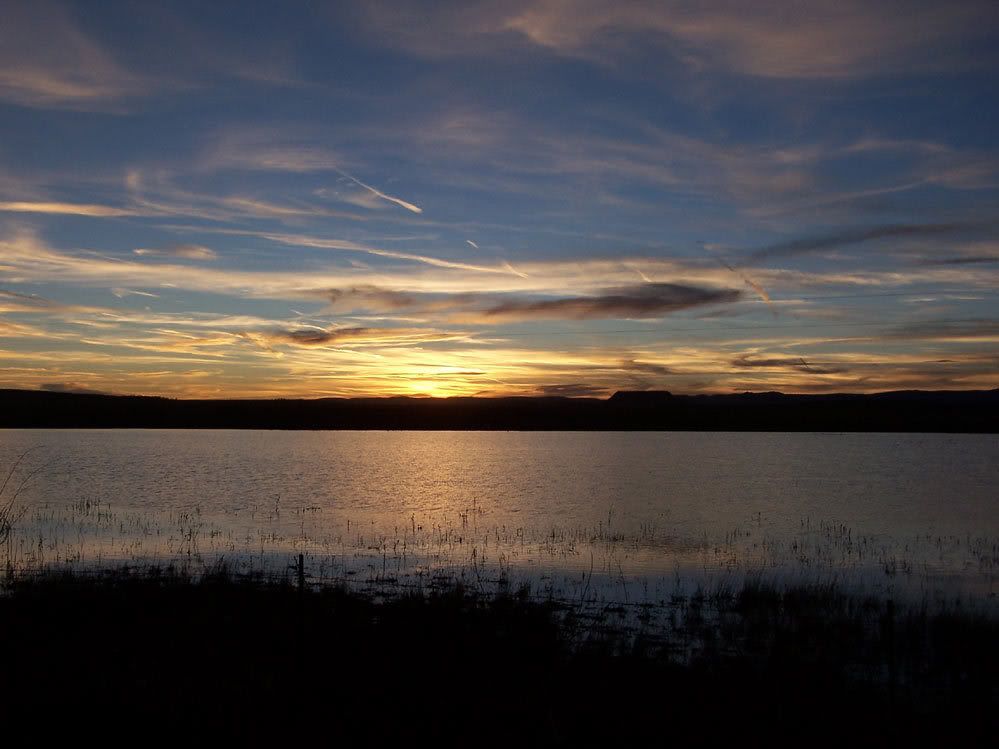
After our Mountain Birding Tour it was time to leave Socorro, New Mexico and head north. We drove to Albuquerque planning to eat lunch at one of our favorite restaurants before heading farther north (and east) to Las Vegas, New Mexico. When we arrived at the location of one of our favorite restaurants we found that Pereas wasn't there. Instead, it had a new name, Seferinos - located on Central and Alvarado. While waiting to be seated we found that the restaurant is run by the same family - known for some of the best true New Mexican fare. My husband had one of his favorite dishes, Carne Adovado, and I had a beef taco plate. We also ordered a couple of sopapillas. After lunch we headed north to Las Vegas, NM, about 60 miles east of Santa Fe. Once we arrived in Las Vegas we felt we should locate a motel before heading over to the refuge. As we exited from I-25 we saw what looked like a brand new, just opened Holiday Inn Express. We found out that it had just recently opened - they had only been opened for two weeks. I can't imagine a motel/hotel having a grand opening in a small (out of the way) town in early November (unless they are anticipating a lot of holiday traffic). We managed to get a suite for the night for only $85. It sure was luxurious. It had a flat panel TV and a king-size bed, with a fridge, microwave and a bar sink. We then headed over to the Wildlife Refuge to see if we could see any cranes flying in for the night. By now it was getting close to sundown. We did see some cranes flying in as well as snow geese. Most ducks and Canada geese had already arrived earlier. Below is what I attempted to capture of a virga in the clouds. And the second photo is the sunset we saw while driving through the refuge. That is Lake McAlister in the sunset photo, which is the largest lake on the refuge.


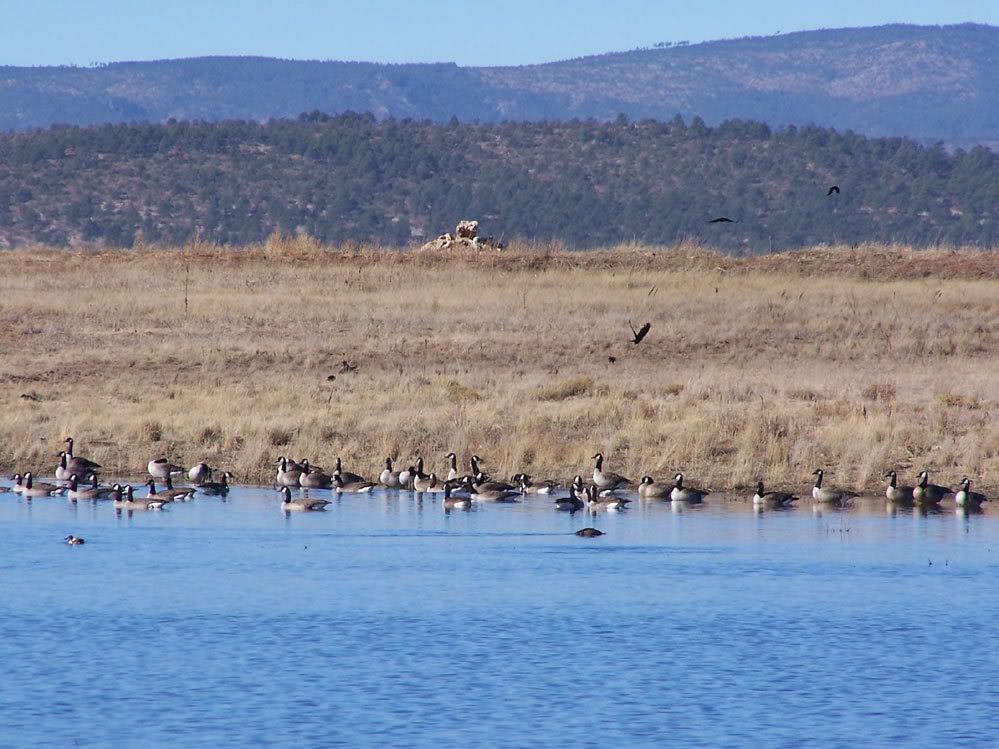
We headed back out to the refuge around 10 a.m (Mon, Nov 19). Below is a flock of Canada geese we saw while driving around.
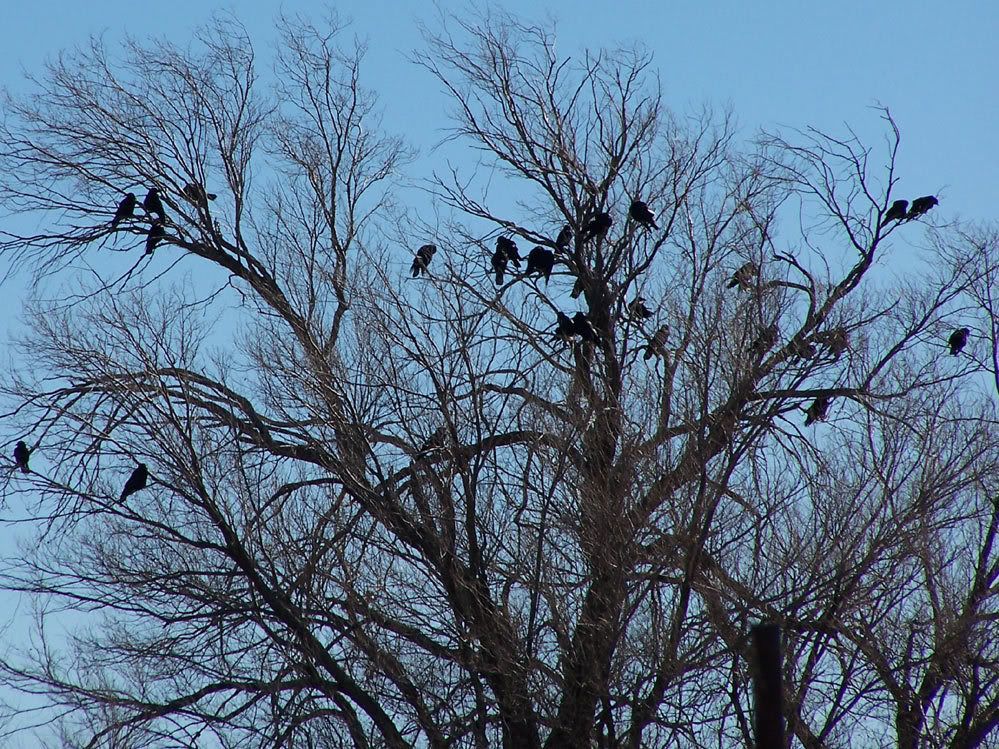
We also saw many ravens throughout the refuge, in the fields and perched in trees.
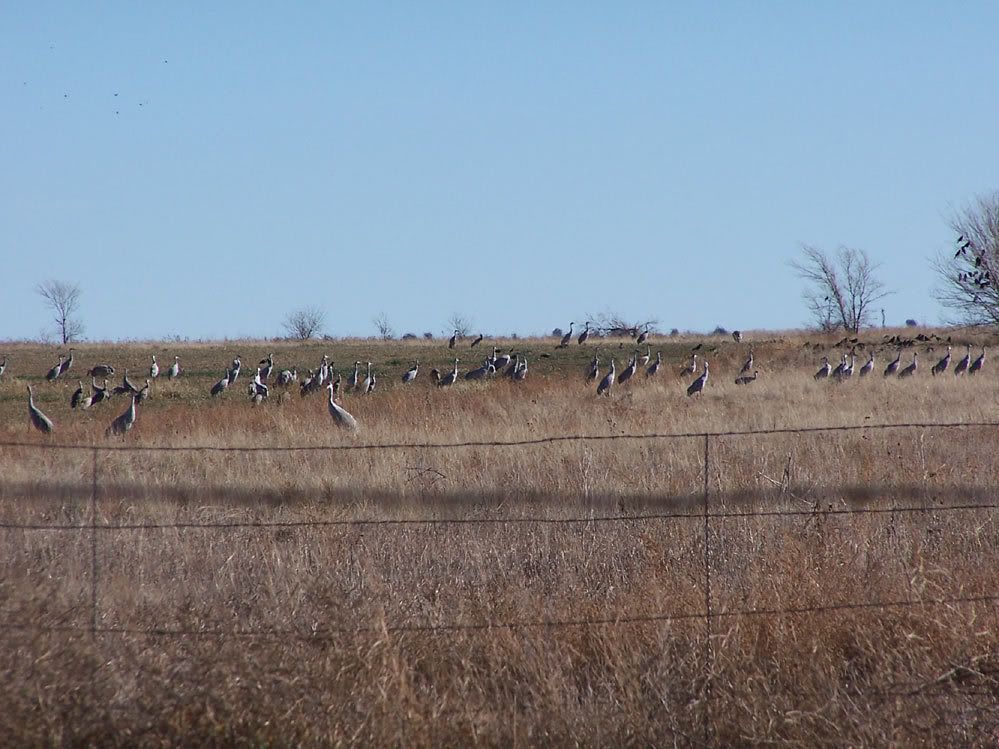
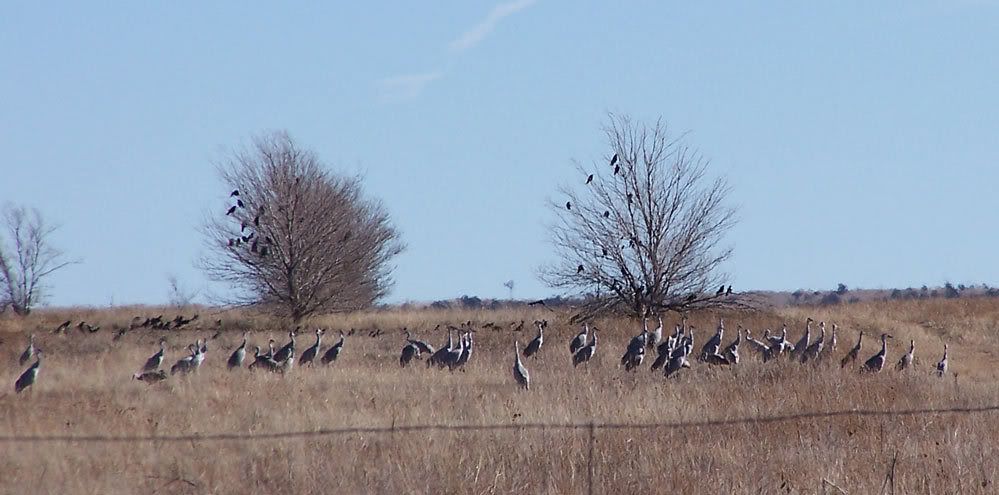
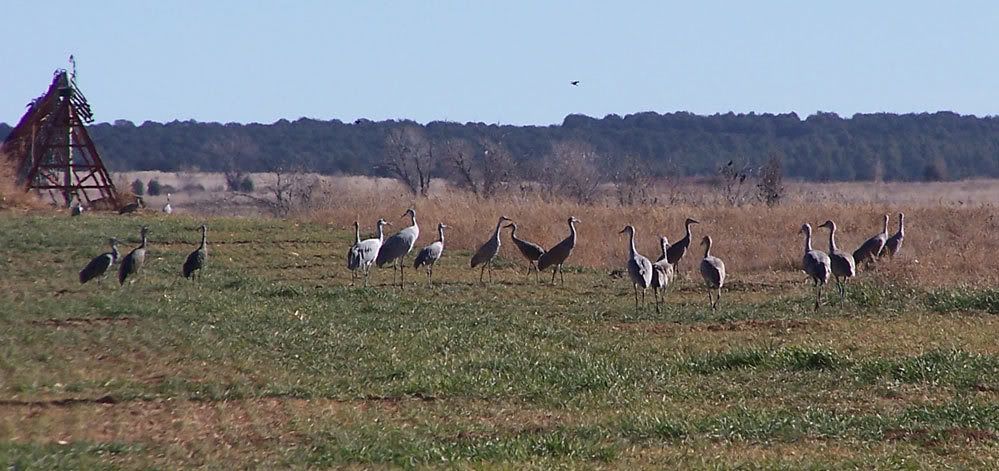
And then we saw sandhill cranes in several fields. Here are a few photos of what we saw.
Notice ravens perched in the trees in the distance.


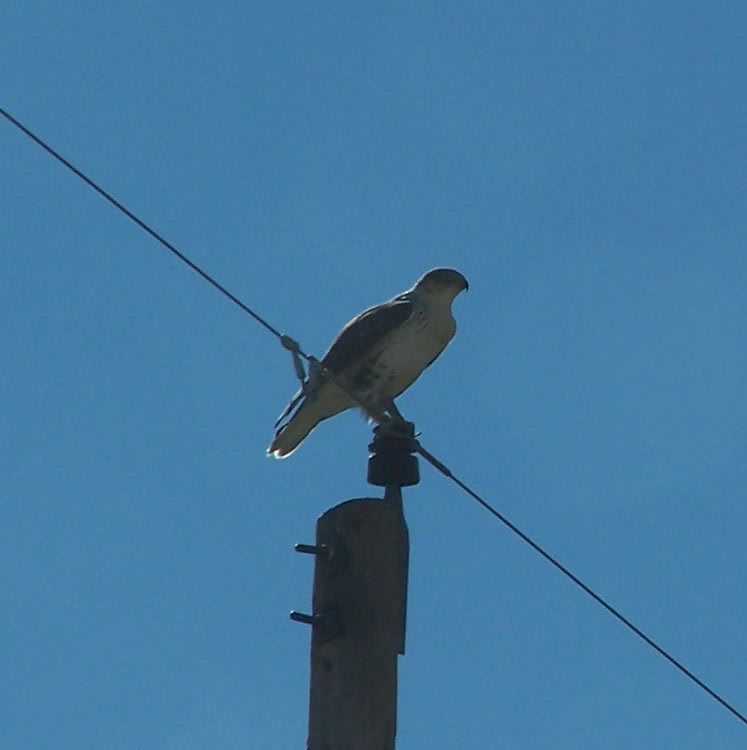
Here we found a red-tailed hawk surveying his territory.
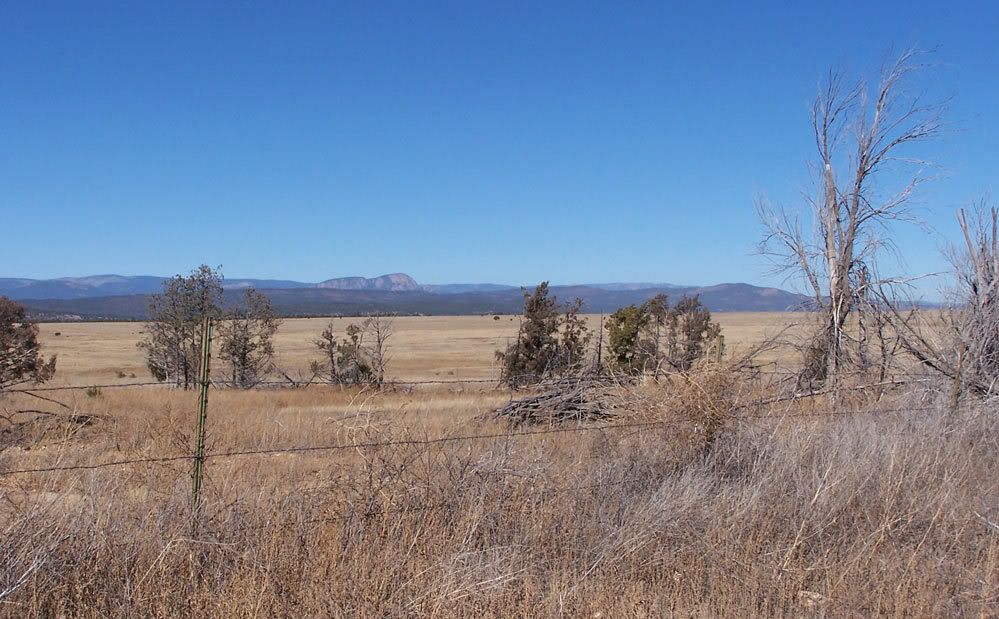
This is a view of the Sangre de Cristo range, part of the Rocky Mountains, in south central Colorado from the refuge.
Stay tuned for part 2 of Las Vegas National Wildlife Refuge. The next post I will provide more photos of other birds we saw.


Current skin is MC Winter 08 and designed by Red.
Best viewed on Firefox at 1024x768, larger or widescreen.