Sunday, December 13, 2009
Elephant Butte Lake State Park

Posted by
Mary C
at
3:30 PM
4
comments
Tags: double-crested cormorants, Elephant Butte, goats, grebes, landscape, rams, white pelicans
Friday, October 10, 2008
Birding Festival - part 2
As we walked down the trail we saw several birds in the pond. They all looked like the bird in the photo below. This was the best shot I could get. I recommend going to Red's blog to see better photos. Anyway, Red has informed me that this is a red-necked phalarope. And there were at least 30 of these birds in the pond. This is apparently their winter plumage and definitely a lifer. Now I wonder if I would recognize these same birds in their breeding plumage.
A little farther down the trail we came to a clearing where we could see quite a bit of Elkhorn Slough. We saw some folks enjoying themselves kayaking. I sure hope I get to do it one of these days. It looks like a lot of fun, and you can certainly see a lot more wildlife up close and personal.
Great egrets abound, and so do brown pelicans. Here is a shot of a great egret that seemed to pose for me. In the background you can see pelicans (well actually they are too far away) about midway (horizontally) in the photo.
The grebe in the center of this photo is a Western grebe. The other two I couldn't ID. But we were told that both Clark's and Westerns are all around in Elkhorn Slough.
These two are pie-billed grebes -- more common birds found in the area. Nonetheless, I think they are cute.
And here is my shot of brown pelicans flying low over the slough. Red has better shots of the pelicans.
Here's another shot of more pelicans flying over the slough. It was funny to watch these birds because they chose to fly only over the slough. They would not necessarily fly over the land, only the water.
Here is another shot of grebes. This one I could better identify them. The farthest left and the farthest right are Westerns. The second grebe on the right is a Clark's. As you will note from a field guide the Western grebe's black cap extends over the eye and has a greenish-yellow bill. The Clark's grebe has a black cap that stops just above the eye and has an orangey-yellow bill. Now just to let you know, if you look closely at the grebe on the far left it has the cap that says "Western." But if you look at the color of the bill it's the color of a "Clark's." Could it be a hybrid? I've heard that it does happen.
Farther down the trail there were fewer birds, but different species we didn't see earlier on the trail. This bird is a long-billed curlew, another lifer.
Another solitary bird -- this is a marbled godwit. I think it's funny this bird was being a loner because I have seen marbled godwits before (at Palo Alto Baylands) and they are found in large flocks. According to Stokes Field Guide these birds are found among moist grasslands in the summer and they winter along the coast. They certainly have an interesting diet -- worms, mollusks, crustaceans, grasshoppers, and pondweed and sedge seeds and tubers.
Now this photo you'll have to take my word for it -- there are many Western Sandpipers in that sandy area. Apparently they have a similar diet to the marbled godwit. But I thought it was strange they were just laying around on the ground. Maybe they decided to sun themselves. They didn't look like they were searching for food. Any other thoughts to why they were on "land" rather than on a watery mudflat?
Posted by
Mary C
at
8:51 PM
9
comments
Tags: egret, Elkhorn Slough, grebes, kayakers, long-billed curlew, marbled godwit, MoonGlow Dairy, pelicans, phalarope, western sandpipers
Friday, January 25, 2008
Birding at Shoreline Lake in Mountain View
Here in a marshy area is a fairly good shot of a male mallard.
This photo shows a Clark's grebe and a surf scoter. I'm not positive about the grebe being a Clark's. The color of its bill says it's a Clark's, but the black on the top of its head seems to be below the eye, which would identify it as a Western grebe. But for now I'll call it a Clark's grebe. Seeing surf scoters on the lake was quite exciting. I had never seen one before - lifer! I can't seem to ID those other "ducks" in the background. You can click on any of the pix to get a larger view.
Here is another lifer - a common goldeneye. Isn't he a beauty? Take note of the choppy waters.
And here is a cutie-"pie." A pied-billed grebe. I think they are some of the cutest of all waterfowl. I think my favorite is the American Wigeon, and the pied-billed grebe is second.
Here is another shot of the pied-billed grebe with (I think) a lesser scaup in the background.
And here is one that is difficult (for me) to identify. The quality of the photo isn't very good, but looking in my guide it seems to look like a ruddy duck, yet its bill has the look of a norther shoveler. Maybe someone can help me identify this one.
Here is another shot of the surf scoter. Is that a female surf scoter next to the male?
Anyway, even though the wind was strong and it more or less shortened our birding time, I think we still had a fruitful afternoon. Other birds we saw were black-crowned night herons and snowy egrets back in the marsh. And we also saw a couple of double-crested cormorants and a few American coots. 
Posted by
Mary C
at
4:30 PM
5
comments
Tags: birding, goldeneye, grebes, mallards, Mountain View, Mt Hamilton, Shoreline, surf scoter
Saturday, October 13, 2007
A short hike and a few birds
Reaching the first three ponds I saw this snowy egret in the middle pond.
As I was watching the snowy egret I noticed a large bird flying around about twenty feet above me. It looked like it was wanting to "land." Well, I guess it was picky where it wanted to land. As you can see from this picture the great blue heron chose to land here next to a snowy egret. What a great opportunity for a photo shoot, comparing the sizes of these beautiful birds. I couldn't imagine these two birds "socializing" with each other. Mmmm. But wait, there's something else in this photo that has me wondering. Take note that the snowy egret's bill is a pale color. Why is that? Is this a juvie? Is that why the bill is a pale color? But all the guides I checked on say the immatures have black bills. I'm really confused on this one.
As I looked across the way on the other side of the trail I saw this great egret. Looks like it just sat there waiting for its picture to be taken.
A little while later the great blue heron decided to move, and flew over to a brushier area, but still close to the pond. Another perfect photo moment. This bird did much the same as the great egret - it seemed to be posing. And it stood there for the longest time, so I was able to get shots of it from various spots. But this was the best shot of all. Isn't this an elegant looking bird, just as elegant looking as the great egret?
In another pond was this Canada goose - all by itself. I guess this bird wanted it that way. But again, I was given another good photo moment. The only problem I had was that this bird was dipping into the shallow water for whatever it is that they eat. So I would have to try and catch this bird in an upright position each time it came up for a breather, which was less than 2 seconds each time. Doesn't that water look serene? And to think there is this noisy freeway about 50 yards to the east of this "serenity."
Off the side of the pond where the Canada goose was I spotted this (I think) ring-billed gull - all by itself. He/she caught a small flat fish and was "playing" with its food. It was fun to just stand there and watch this bird. It would hold the fish in its bill, then drop it, then peck at it (even though it was totally dead), then pick it up and hold it its bill, drop it, and peck at it again, etc. You could say I was being totally entertained by all these "solitary" birds.
I then decided to walk the trail a little further, heading north. And on the trail I came across quite a few scrub oaks. And here is a shot of their fruit. I guess you can say it's fall around here - we have subtle ways of seeing the seasonal changes around here.
As you walk further down the trail it's like you are straddling between the ponds and you are on a higher road where the vegetation is drier, and the water is farther down the hill on each side. There are some power lines crossing over the trail and there are always some birds perched on these wires. Across the way were these double-crested cormorants. I wouldn't believe it if I hadn't seen it for myself. There were at least a dozen cormorants spread out, perched on the wires. Closer to me, just above me, were about the same number of rock pigeons. As I'm standing there taking pix of the cormorants I sensed something else flying around out of the corner of my eye. I stopped to see if I could ID the bird. Well, it finally perched itself in the top of a tree. The tree was about twenty feet ahead of me. I caught a beautiful sight of (I think) a sharp shinned hawk in my binoculars, but when I went for my camera, by the time I focused in on the bird.... Yes, we've all had these stories -- kind of like a fisherman's story of the big one that got away. ;-) Meanwhile, I looked up at the pigeons and told them that one of them will probably be his/her dinner for the evening.
I guess another good sign of fall around here are all the places we find lots of spider webs. I saw this on the trail not far from the power lines. This whole area of vegetation was full of webs. How about that blue sky for a background?
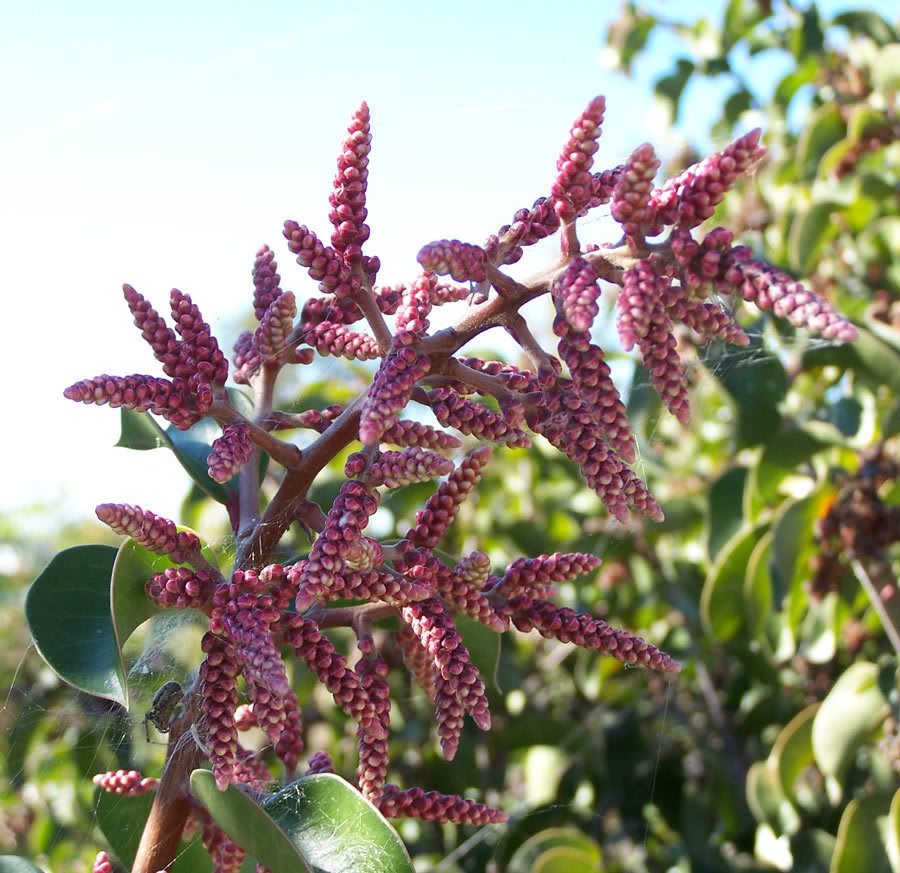
And here is another form of fruit from another plant growing in abundance on the trail. I think it is so attractive, even though it did have quite a bit of webby material around it. Click on it to enlarge to see the webby material.
In addition to the birds mentioned above, I also saw pied-billed grebes, mallards, American coots, killdeer, one black phoebe, several song sparrows, and a few red-wing blackbirds. Overall, I saw a total of 14 species. Not bad for a two-hour walk.

Posted by
Mary C
at
9:15 AM
12
comments
Tags: blackbirds, Canada geese, coots, cormorants, egrets, grebes, gulls, herons, killdeer, Los Gatos Creek Trail, mallards, phoebe, sparrows
Thursday, July 19, 2007
Tule Lake and Lower Klamath NWR
Here is a better view of the Lava Beds in the foreground and Tule Lake in the background. My husband and I drove over to the Tule Lake/Klamath Basin Visitor Center and saw a robin, a couple of Brewer's blackbirds, and a lizard. The lizard was sitting on the wall sunning himself and allowed me the privilege of getting a snapshot of him.
While touring around Tule Lake and Lower Klamath we encountered Western Grebes, Clark's Grebes, and even a horned grebe. We saw several flocks of ibises in flight. That was quite a sight to see. We also saw coots, a common merganser, a double-breasted cormorant, many yellow-headed blackbirds, and a northern harrier. Here are some other photos I took.
I think this is milkweed. Can someone verify this for me?
Another wildflower I cannot identify - but there were quite a few of these all around. It looks like something caterpillars and butterflies, or even dragonflies, etc. would make use of. As a matter of fact, throughout the entire trip there was a plethora of dragonflies, darning needles, and damselflies everywhere we went.
Clark's Grebes
White-faced ibis. Second photo also includes a Brewer's blackbird.
And here is a double-breasted cormorant with his "harem" of gulls.
And if you click on these photos you can get a better view of the red-wing and yellow-headed blackbirds on these tule reeds.

Posted by
Mary C
at
7:54 AM
2
comments
Tags: blackbirds, coots, cormorant, grebes, ibises, lizard, Lower Klamath, merganser, Tule Lake